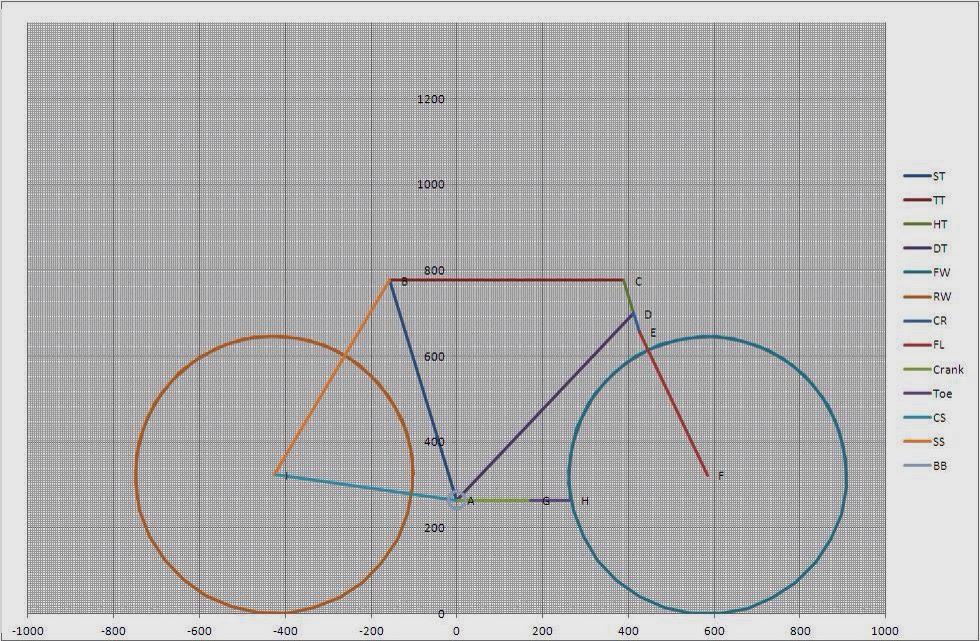
One of the major reasons for buliding a custom frame is so that it can be measured to fit. Commercially produced bikes are, understandably, produced for the 'average person', with the ST length being the de facto criterion used for sizing. In the past, when most bikes had horizontal top-tubes, this measurement was comparable between bikes, so standover height for the prospective buyer was a simple calculation. Now, however, with sloping TTs this measurement is practicaly meaningless so any realistic idea of fit usually requires a trip to the LBS to try out a prospective purchase. In reality, ST height is not the most important measurement; provided there is sufficient standover height, to ensure the safety of the family jewles in the event of an unexpected forward dismount, the ST length can be easily changed by changing the saddle height. More important is the TT length combined with the stem length, because this determines the reach, which has a major influence on upper body position and comfort. However, upper body measurements are not considered when selecting a bike unless you pay for a professional bike fit which might cost upward of £150.
So what is the secret? There are several methods of bike fitting which have been used, mostly based on the Italian C.O.N.I. method (C.O.N.I., 1972). Many framebuilders developed their own methods based on this, or by combination of their own experience as cyclists and customer feedback.
In my search for the perfect algorithm I have come to the conclusion that there is no such thing because everyone is different (surprise) and has slightly differing requirements from their bike, so I tend towards a method based on some general principles allied with previous riding expiecnce and an understanding of the purpose to which the bike is to be put - this seems to be the approach adopted by custom framebuilders to greater or lesser extent, with the following general principles seeming to apply:
- Take measurments of the inside leg, sternum, and arm length.
- Decide on the ST length based on this measurement.
- Use tables and/or various formulae to get an estimate for the TT and stem length.
- Measure one of your bikes that you already own and feel comfortable on, and compare to the measurements above.
- Decide on HT angle to suit the type of riding.
- Decide on ST angle to suit the type of riding and your physiology.
- Arrive at an optimal solution using the above data and experience based on riding thousands of miles under a variety of circumstances.
As you can see, this is not a terribly helpful set of instructions, but is an accurate reflection of my current state of knowledge. In summary, I have concluded that there is no magic formula and experience of bike riding plays a not insignificant role. That said, for this build, I followed this procedure:
- Use 'Method 3' in the C.ON.I. manual
- Take anatomical measurements: Inside leg, A = 83.5 cm; Height, A1 = 176 cm; Arm length, A2 = 63 cm; Foot length = 26 cm, as shown in the image above.
- Calculate ST length using the formula F = A - (C + D), where C is the saddle extension and D is the crank length. Using the relevant values from the table in th manual this computed to a ST length of F = 83.5 - (14.5 + 17.5) = 52 cm.
- Calculate the TT length using the formula H = F +\-G, where G is a factor to be added or subtracted depending on the size of the frame. Hence, H = 52 + 1.5 = 53.5 cm.
- This ensures that the ST and TT lengths are within proportional limits for the frame. The advice is to then adjust the effective TT length for large or small riders by adjusting the length of the stem (B) and saddle position to obtain the correct reach.
- Choose a ST angle to suit the type of riding and rider physiology - I am larger in the upper body than the pelvis so decided on a shallower ST angle of 72 deg to bring my centre of gravity back a bit.
- Choose a BB height to suit the type of riding - I wish to use the bike for audax/touring so chose a BB heigth of 26.5 cm which is at the lower end of the limit (26 to 30 cm) because a great deal of clearance will not be required.
- Choose a HT angle to suit the type of riding. I chose a compromise of 73 deg because I want the bike to have responsove steering but also to be comfortable. Fork rake, trail and tyre size will also play an important part in this, but more of that later.

Having done all this, for comparison, I then measured the bike which I currently use for touring, a Specialized Tricross, and got the following measurements (taking into account sloping TT to obtain the effective horizontal TT length): ST = 53.5; TT = 53.5; BB height = 26.6; Stem length = 9.7; ST angle = 73.5 deg; HT angle ~73 deg. I have used the Tricross for a number of years and understand pretty well how my body feels on it. First, the ST length is longer, but this is not that important because it is well within the range of saddle height adjustment. Second, the TT length is exactly the same, but I find that my body feels too far forward with too much of my weight on my arms, so the intention to reduce the ST angle from 73.5 to 72 deg would seem sensible, with the option of changing the stem length and moving the saddle to adjust for reach. Bearing in mind that the Tricross is a cross bike and not really desogned for touring, these conclusions seem to make sense, to me at least.
In the next post I will describe the full design using my 'homemade' spreadsheet.
References
C.O.N.I. (1972). Cycling, Central Sports School - F.I.A.C., Rome.